With the rapid development of science and technology, wireless communication technology continues to innovate, Ultra-Wideband (UWB) technology with its high-precision positioning, low delay, high bandwidth and other characteristics, in the field of outdoor positioning and ranging has shown great application potential. However, as an important part of electronic equipment, the power consumption of chip has always been a key factor restricting its wide application. In this paper, the power consumption of outdoor UWB chip will be deeply discussed, in order to provide useful reference for research and development and application in related fields.
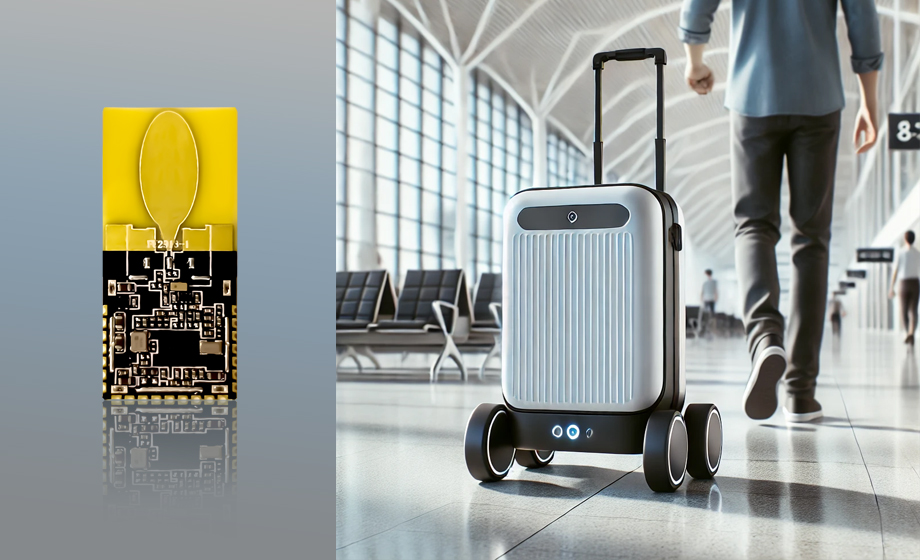
I. Overview of UWB technology and its application in outdoor positioning and ranging
UWB technology is a kind of wireless communication technology that transmits data by non-sinusoidal narrow pulse from nanosecond to microsecond. Due to its extremely narrow pulse width, it has very high temporal resolution and spatial resolution, which makes UWB technology has a natural advantage in positioning and ranging. In the outdoor environment, UWB technology can achieve centimeter-level positioning accuracy, and is not affected by light, weather and other conditions, so it is widely used in UAV navigation, intelligent vehicle positioning, outdoor sports track tracking and other fields.
Second, the influence factors of UWB chip power consumption
The power consumption of UWB chip is mainly affected by the following aspects:
Chip design: The design structure, manufacturing process and material selection of the chip will directly affect its power consumption level. Optimized chip design, low power circuit and advanced packaging technology can effectively reduce the power consumption of the chip.
Working mode: UWB chip in different working modes, power consumption will also be different. For example, in standby mode, the chip consumes less power; In high-speed data transmission mode, the power consumption is relatively high. Therefore, choosing the right working mode according to the actual application scenario is of great significance to reduce the chip power consumption.
Environmental factors: The outdoor environment is complex and changeable, and factors such as temperature, humidity, and electromagnetic interference may affect the power consumption of the UWB chip. Therefore, in chip design and application, it is necessary to fully consider environmental factors and take corresponding measures to reduce power consumption.
Third, strategies and methods to reduce UWB chip power consumption
For the UWB chip power consumption problem, it can be optimized from the following aspects:
Hardware optimization: Reduce the power consumption of the chip in the working process by improving the chip design, optimizing the circuit layout, and using low-power materials. For example, the use of advanced manufacturing technology, reduce the size of the chip, reduce power consumption; Optimize power management circuit to improve power utilization efficiency; Low power communication protocols and algorithms are used to reduce power consumption during data transmission.
Software optimization: Through software level optimization, reduce the power consumption of the chip when processing data and performing tasks. For example, the use of energy-saving algorithms to reduce unnecessary calculations and data transmission; Optimization of task scheduling strategy, reasonable allocation of chip resources to avoid resource waste; Realize intelligent sleep and wake up mechanism, dynamically adjust the working state of the chip according to actual needs.
Environmental adaptability design: According to the particularity of outdoor environment, the UWB chip with environmental adaptability is designed. For example, temperature compensation technology is used to reduce the influence of temperature on chip power consumption. Increase electromagnetic shielding measures to reduce the impact of electromagnetic interference on chip performance; Optimize the stability of the chip in harsh environments, ensuring that it can maintain low power consumption in a variety of environments.
4. UWB chip power consumption test and evaluation method
In order to accurately evaluate the power consumption performance of UWB chip, it is necessary to adopt scientific testing and evaluation methods. Here are some common testing and evaluation methods:
Power testing instrument: Use a special power testing instrument to measure the power consumption of the UWB chip. These instruments can monitor the current, voltage and other parameters of the chip in the working process in real time, so as to calculate the power consumption of the chip.
Simulation: Simulation software is used to simulate the working process of UWB chip and predict its power consumption performance. This method can preliminarily evaluate the chip power consumption in the design stage and provide a basis for the subsequent optimization.
Actual scenario test: Test the power consumption of devices equipped with UWB chips in an outdoor actual scenario. By collecting the power consumption data in the actual use process, the power consumption performance of the chip in different environments is analyzed to provide guidance for practical applications.
The future development trend of UWB chip power consumption
With the advancement of science and technology and the deepening of application, the power consumption problem of UWB chip will be solved more effectively. In the future, the development trend of UWB chip power consumption is mainly reflected in the following aspects:
Continuous reduction in power consumption: With the continuous progress of chip manufacturing processes and circuit design, the power consumption of UWB chips will continue to be reduced to meet the needs of more low-power application scenarios.
Enhanced environmental adaptability: In view of the complexity of outdoor environments, future UWB chips will pay more attention to environmental adaptability design, which can maintain stable power consumption performance in a variety of harsh environments.
Intelligent management: Future UWB chips will pay more attention to intelligent management, through intelligent algorithms and machine learning technology, to achieve more accurate power control and optimization.
Diversified applications: With the rapid development of the Internet of Things, intelligent manufacturing and other fields, UWB chips will be applied to more fields to promote the continuous improvement and optimization of its power consumption performance.
Vi. Conclusion
The power consumption of UWB chip is a complex problem involving hardware, software and environmental factors. By means of hardware optimization, software optimization and environmental adaptive design, the power consumption of the chip can be effectively reduced, and the performance and stability of the chip in practical applications can be improved. In the future, with the continuous progress of technology and the continuous expansion of application scenarios, the power consumption problem of UWB chip will be better solved, providing more reliable technical support for the development of outdoor positioning and ranging fields.